Department store shopping has an image problem. The format itself — wide aisles, seasonal floor resets, rack-dense layouts — encourages the kind of browsing that accumulates items rather than builds a wardrobe. A shopper who enters without a framework leaves with things that fitted the moment and nothing that fits the week after. Kohl's occupies an interesting position in this landscape: a mid-tier department store with a genuine breadth of brand partnerships, a loyalty rewards structure that can meaningfully reduce the cost of a planned purchase, and a clearance cadence that rewards the patient, list-driven buyer. Used deliberately, it is one of the more efficient places to close gaps in an everyday wardrobe.
This is a reader-supported guide. Some links below are affiliate links. If you make a purchase through them, Last Meadow Guide may earn a commission at no additional cost to you. Prices, promotions, and product availability vary by location and date; always verify current offerings before completing a purchase.
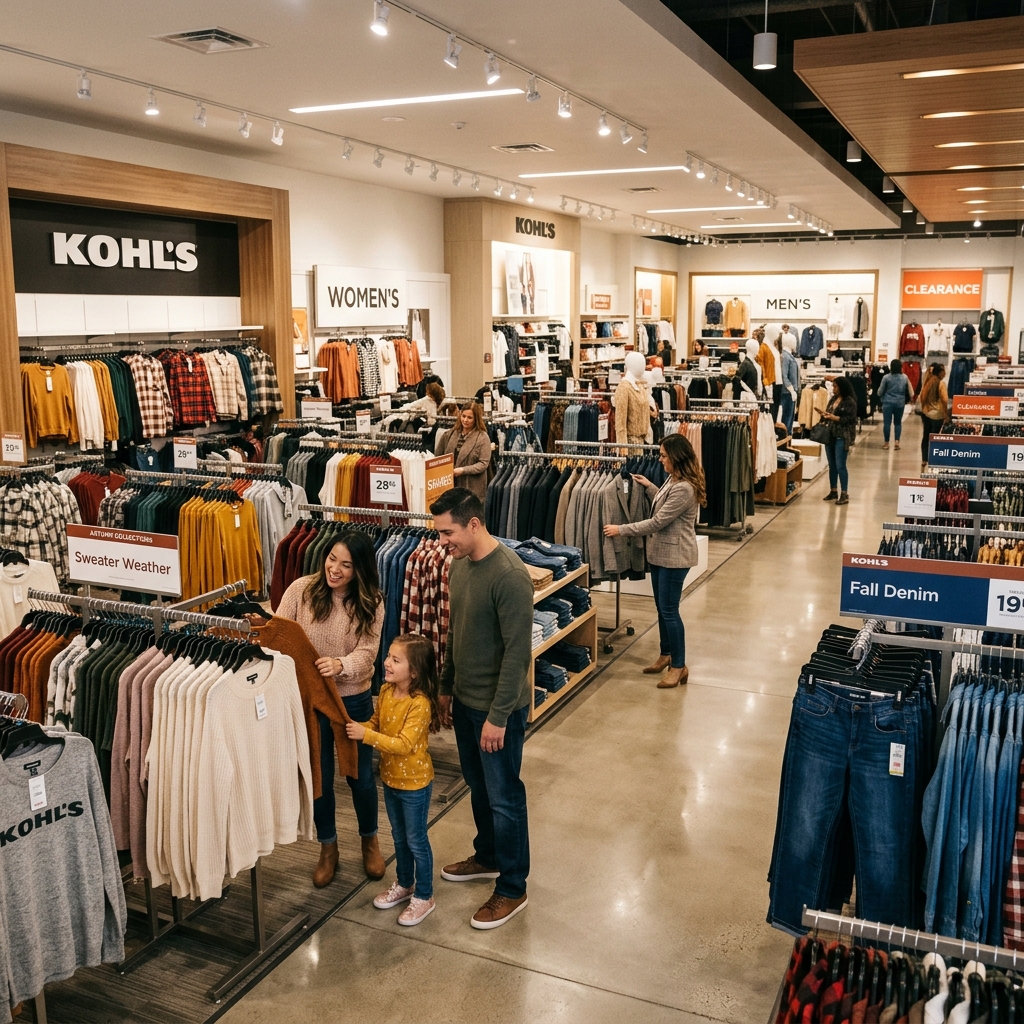 Above: The Kohl's floor plan separates departments clearly by category and gender — a layout that supports a focused, list-driven approach to shopping rather than open-ended browsing.
1. Understanding Kohl's Position in the Mid-Tier Retail Landscape
Kohl's is not a luxury retailer, and it does not position itself as one. What it offers instead is a consistent assortment of nationally recognized brands — Levi's, Columbia, Adidas, Nike, Carhartt, Vera Wang, Haggar, Sonoma — at a price tier that sits below department store full-price retail and above discount-only formats like off-price chains. This middle position is where the store's value proposition lives, and it is only legible to a shopper who arrives with a specific need and a price reference point.
The danger of mid-tier retail is the same in every format: a shopper who does not know what they paid for the same item at full price cannot evaluate whether the current Kohl's tag represents a good deal, a marginal deal, or simply a lower starting price with an inflated "compare at" figure. The solution is not distrust — it is preparation. A shopper who knows that a specific Levi's 505 jean retails at a major denim retailer for $69 and finds the same SKU on a Kohl's rack marked at $44.99 with a current sale event stacking an additional 20% off has real data to make a real decision.
This is the fundamental discipline that separates deliberate Kohl's shopping from impulse spending in a large, well-lit room.
2. The Brand Roster: What Each Department Actually Carries
Kohl's brand partnerships vary meaningfully by department. Understanding the strongest categories allows a shopper to concentrate effort where the store has genuine depth and avoid sections where the assortment is thinner.
Men's Apparel
The men's department carries a strong everyday and workwear assortment. Sonoma Goods for Life — Kohl's private label — covers casual basics including chinos, knit polos, fleece, and casual button-downs at a price point that undercuts comparable mid-market brands. The quality is suitable for non-formal everyday wear and weekend rotation. Alongside Sonoma, the men's floor typically carries Levi's across its core fits (505, 511, 514), Haggar for dress trousers and chinos, and Carhartt for heavier workwear in flannel, canvas, and duck cloth.
The athletic section brings Nike, Adidas, Under Armour, and Columbia into the same floor space. For a buyer planning a single visit to address both a workwear gap and an athletic layer need, this breadth is genuinely useful — it eliminates the need for two separate store trips at two separate price tiers.
Women's Apparel
The women's floor has the widest brand range in the building. LC Lauren Conrad, Vera Wang Simply Vera, Nine West, and Elle anchor the contemporary and elevated-casual sections. The Lauren Conrad line in particular occupies a position between high-street fast fashion and accessible premium — construction quality varies across categories, but the outerwear and knitwear sections consistently represent fair value at their standard prices and exceptional value during promotional stacking.
Croft & Barrow covers the workwear basics tier: slacks, blouses, and structured cardigans at prices that compete directly with value-segment alternatives without requiring the sacrifice of fabric weight and seam construction that defines the cheapest tier.
Home and Bedding
Kohl's home section carries The Big One (its home private label), Food Network branded kitchen goods, and a rotating selection of name-brand cookware and bedding. For a deliberate home buyer, the bedding section is worth specific attention: thread-count-comparable sheet sets consistently appear at lower price points during the regular promotional cycle than equivalent offerings at specialty home retailers. The key qualifier is that promotional pricing here is almost always time-limited; the same set at non-promotional full price is less competitive.
3. The Kohl's Cash Mechanics: How the Rewards Structure Actually Works
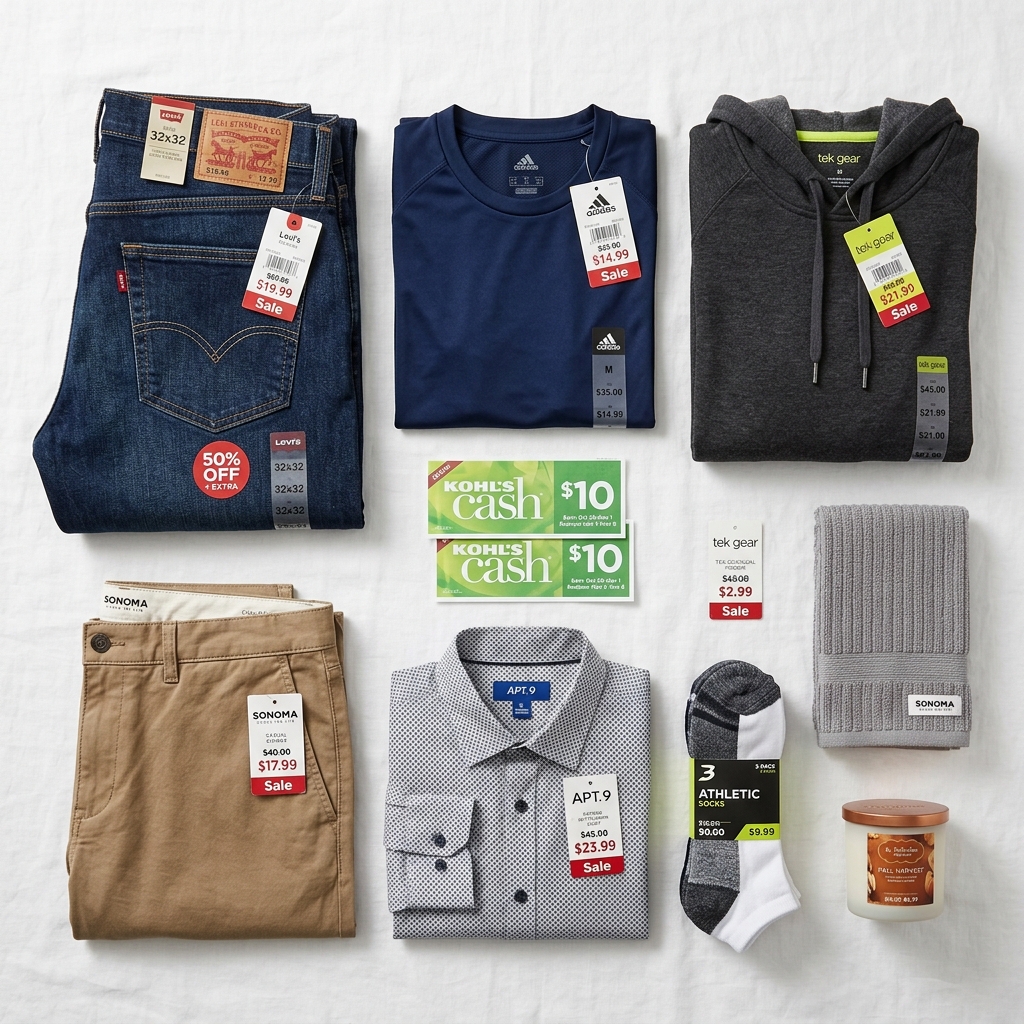 Above: Kohl's Cash certificates earned during qualifying purchase events can be applied to a subsequent transaction — creating a two-stage discount structure that rewards shoppers who plan across purchase cycles.
The most structurally important element of shopping at Kohl's is not the sale event. It is the Kohl's Cash program. Understanding how it works determines whether a shopper uses it as a genuine savings mechanism or allows it to manufacture purchases that would not otherwise occur.
How Kohl's Cash Is Earned
Kohl's Cash is issued during defined promotional earning windows, typically earning $10 in Kohl's Cash for every $50 spent on qualifying purchases. The earning window and the redemption window are separate: a shopper earns Kohl's Cash during one period and redeems it during a subsequent, defined window. The certificates expire at the end of the redemption window.
The Two-Purchase Discipline
The Kohl's Cash structure rewards shoppers who think in two-purchase cycles rather than single transactions. The optimal use is:
-
Purchase 1 (Earning window): Buy items you have already planned to buy and that are on your pre-visit list. Do not add items to reach a Kohl's Cash threshold unless those items were already on your list. Threshold-chasing is how a $50 purchase intended to earn $10 in Kohl's Cash becomes an $80 purchase with $10 in Kohl's Cash and $20 in unneeded items.
-
Purchase 2 (Redemption window): Return for a second planned item — a replacement item you know you need, a seasonal piece you have been tracking — and apply the Kohl's Cash certificate as a direct deduction from the transaction total.
Used in this sequence, Kohl's Cash functions as a meaningful discount on a second planned purchase. Used impulsively, it is a marketing mechanism that creates the feeling of saving money while increasing total spend.
The value of a Kohl's Cash certificate is exactly $10 applied to a purchase you would have made regardless. Its value is zero applied to a purchase you made only because you held the certificate.
Kohl's Rewards and the My Kohl's Card
The My Kohl's Card — the store's credit card — adds a percentage-back earnings layer on top of the Kohl's Cash program. Cardholders earn points on every purchase that convert to Kohl's Rewards, stacked alongside standard Kohl's Cash earning during promotional events. For a shopper who already buys clothing and home goods at Kohl's on a regular basis and pays the card balance in full each billing cycle, the stacking of Kohl's Cash plus Rewards represents a real reduction in effective cost per purchase.
The qualification — paying the balance in full — is non-negotiable from a value perspective. Any interest charges on a revolving Kohl's credit card balance will exceed the rewards earned on that balance within one to two billing cycles.
4. The Sale and Clearance Cadence: When the Prices Are Actually Good
Kohl's operates a near-continuous promotional cycle. At any given point, some percentage of the floor is on sale. This structure creates a decision problem: if everything is always on sale, is anything actually discounted?
The answer requires distinguishing between promotional sales and clearance markdown.
Promotional Sales (Percentage Off Storewide)
These are the 15% off, 20% off, or 30% off storewide events that appear frequently in email communications and on-site banners. They are real discounts applied at checkout — but they apply to the standard compare at price, which is not always the price you would find at a competing retailer. Promotional sales are most valuable when applied to items whose standard Kohl's price is already competitive with the market and where the additional percentage creates a meaningfully lower final price.
Clearance Markdown (End-of-Season)
The clearance rack is where the most significant discounts appear. End-of-season markdown cycles — typically occurring as a new seasonal floor reset is being set — reduce items to 50%, 60%, and in some cases 70% off original retail. The practical limitation is size and style availability: clearance merchandise represents what did not sell during the primary season, which means the strongest sellers in popular sizes will already be gone.
The deliberate shopper's approach to clearance is to arrive with specific size information rather than a general intention to browse. Know your measurements across the brands that Kohl's carries. A clearance sweep conducted with fit knowledge produces results; one conducted by feel produces a bag of items that need to be returned.
5. Online vs. In-Store: Where Each Format Has an Advantage
Kohl's operates a full e-commerce platform alongside its physical store network. The two channels are not interchangeable in their product and pricing behavior.
In-Store Advantages
Physical stores allow fit verification — the single most important variable in clothing purchases. A garment that fits correctly on the rack is the only garment worth buying. Additionally, in-store clearance pricing sometimes differs from the online clearance price, and in-store items on the clearance rack are immediately available without shipping lag or the risk of a size selling out between cart and checkout.
Online Advantages
The Kohl's website provides a more complete size range than any individual store location maintains in stock. For buyers with fit profiles that fall outside the center of the size distribution — extended sizes, petite lengths, tall lengths — the online assortment is substantially wider than what the local store floor carries.
Online ordering also enables price comparison in a way that in-store browsing does not. A shopper can open a second browser tab and verify the current price of the same item at a competing retailer before completing the Kohl's checkout. This verification takes ninety seconds and eliminates the regret of discovering a better price elsewhere after the receipt is printed.
6. A Practical Kohl's Shopping Checklist
Before entering a Kohl's store or loading the website, resolve these five points:
-
List first, browse second. Write the specific items you need before you arrive. Categories are not sufficient — identify the garment type, the intended use context, the acceptable color range, and the maximum price you will pay. Arrive with the list visible on your phone.
-
Know your brand sizes. Kohl's carries multiple brands with different fit conventions. A Medium in Sonoma is not the same as a Medium in Under Armour. Know your measurements in the specific brands you plan to buy before you arrive.
-
Check the current Kohl's Cash earning window. If a promotional earning window is active, your planned purchase will generate a certificate. Note the redemption window dates and plan your second visit accordingly.
-
Verify the clearance cycle timing. Ask a floor associate when the most recent seasonal markdown occurred, or look for the densest concentration of red clearance tags on the floor — this indicates a fresh markdown that has not yet been picked over.
-
Compare before you commit online. For any item priced above $30 in the online cart, check the same brand and model at one competing retailer before checkout. If Kohl's is competitive or lower, complete the purchase. If not, decide whether the Kohl's Cash earning or rewards stacking makes the difference.
The Case for Using Kohl's as a Planned Wardrobe Resource
The strongest version of Kohl's as a retail tool is not an impulse destination but a planned wardrobe resource. A shopper who maintains a running list of specific gaps — a pair of Levi's in a worn-out size, a Columbia fleece mid-layer for the coming season, a set of Tek Gear training shorts — can cross-check that list against the current promotional calendar and clearance cycle to identify the moments when the specific item they need is available at the price they have already decided is acceptable.
That approach removes the emotional dimension of retail shopping — the deal pressure, the urgency, the manufactured scarcity — and replaces it with a simple match: does this item, at this price, on this date, fill a need I have already documented?
When the answer is yes, Kohl's is a genuinely useful place to complete that transaction efficiently and with the Kohl's Cash structure adding a documented discount to a subsequent planned purchase.