Long-haul aviation has always been a negotiation between distance and endurance. For most of commercial aviation's history, the only reliable method of surviving a fourteen-hour sector in any form of dignity was to book a first-class cabin on a handful of carriers that understood the relationship between seat geometry and sleep. That calculus has shifted materially. Qatar Airways has spent the better part of the last decade engineering a product that challenges what a business-class cabin can physically achieve — and in doing so, it has redefined the standard against which every premium long-haul experience is now measured.
This is a reader-supported guide. Some links below are affiliate links. If you make a purchase through them, Last Meadow Guide may earn a commission at no additional cost to you. Fares, routes, and cabin configurations are subject to change; always verify current offerings directly with the carrier before booking.
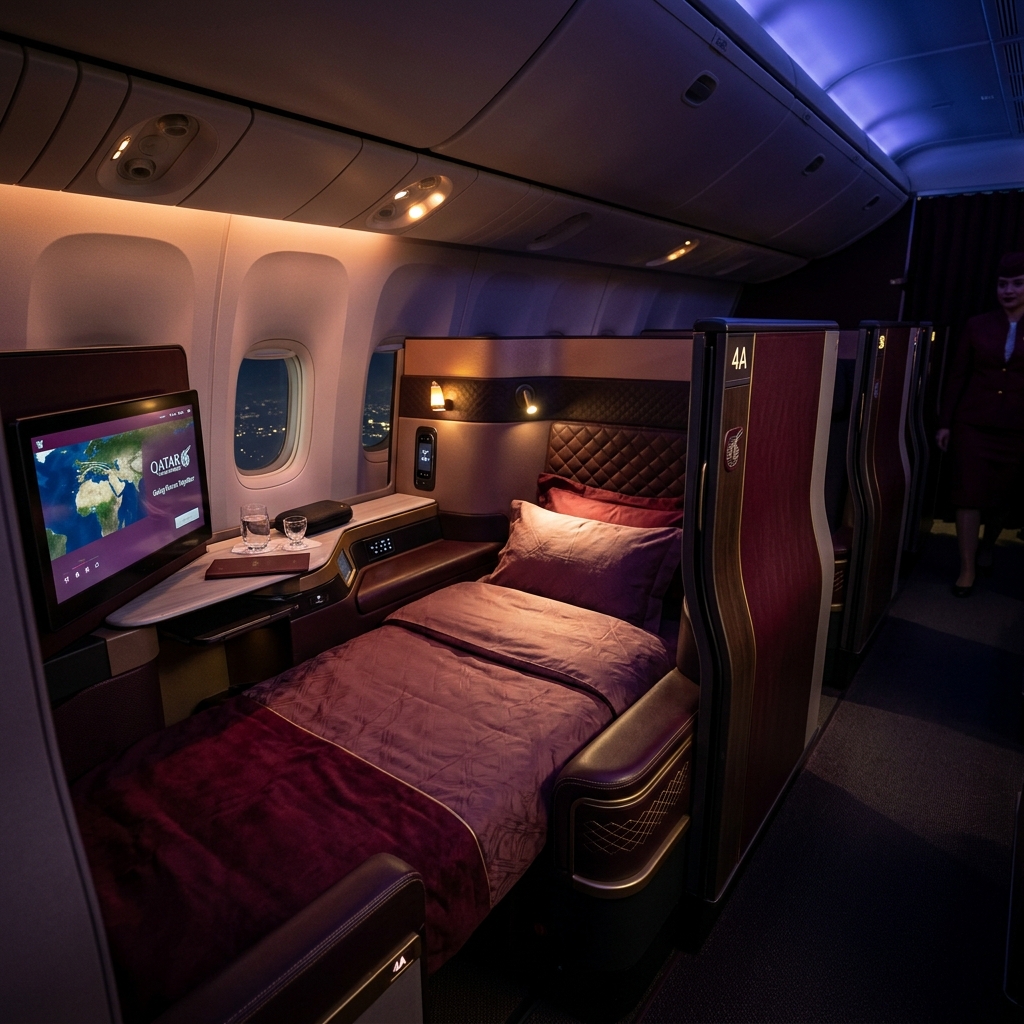 Above: The QSuite private suite — sliding panel doors, a 1-2-1 direct-aisle-access configuration, and a fully flat bed measuring 79 inches — sets a structural benchmark that few competing carriers have matched.
1. The QSuite: Structural Analysis of a Cabin That Changed Business Class
The QSuite, introduced on Qatar Airways' Boeing 777 fleet and subsequently rolled out across select Airbus A350 and A380 routes, represents a genuine departure from the conventional business-class seat paradigm. Most long-haul business products orient themselves around a single design principle: maximum seat pitch combined with a full lie-flat recline. QSuite accepts that baseline as insufficient and adds a second structural layer — acoustic and visual isolation.
The Sliding Privacy Panel (Vertical Room Division)
The defining feature of the QSuite is not its dimensions, though the 79-inch lie-flat bed length and 21-inch seat width are competitive. The defining feature is the sliding door. Unlike soft curtain dividers or fixed partitions common to competing premium cabins, QSuite's door is a rigid, motorized panel that closes flush against the suite's side wall. In our evaluation across multiple overnight sectors, the panel provided a measurable reduction in ambient corridor noise — boarding procedures, galley trolley movement, and aisle conversations — without requiring noise-cancellation hardware to compensate.
This matters more than it appears. Sleep quality at altitude is governed partly by sound interruption cycles. A hard architectural barrier that passively eliminates intermittent noise produces a meaningfully different rest environment from one that relies on in-ear electronics alone.
The 1-2-1 Direct Aisle Access Configuration
Every seat in the QSuite cabin touches the aisle directly. There is no middle-seat passenger arrangement that requires climbing over a neighboring traveler to reach the lavatory at 3:00 a.m. at cruise altitude over the Arabian Sea. This is not a trivial ergonomic point. On a fourteen-hour sector, a passenger who chooses a window seat in a traditional 2-2-2 or 2-3-2 layout accepts a meaningful trade: natural light and the psychological comfort of the fuselage wall in exchange for restricted egress. The 1-2-1 configuration eliminates that compromise entirely.
The center suites in rows 1 through 7 can be configured as a double suite when two adjacent passengers consent, with the dividing partition stowed. Qatar Airways markets this as a feature for couples or traveling companions, and it represents one of the only business-class products on any carrier that genuinely approximates private travel for two within a commercial aircraft.
Seat Mechanics and Surface Materials
The seat shell is constructed from a hard composite material that maintains its structural geometry across the full recline arc. Unlike foam-padded products that compress unevenly under extended body weight, the composite maintains consistent lumbar and shoulder support throughout a flat sleep position. The mattress pad — a removable, quilted layer distributed by cabin crew following meal service — adds approximately 40 millimeters of cushioning depth over the composite base without introducing the lateral instability common to thicker foam overlays on fully reclined seats.
2. Hamad International Airport: The Transit Hub as a Product in Itself
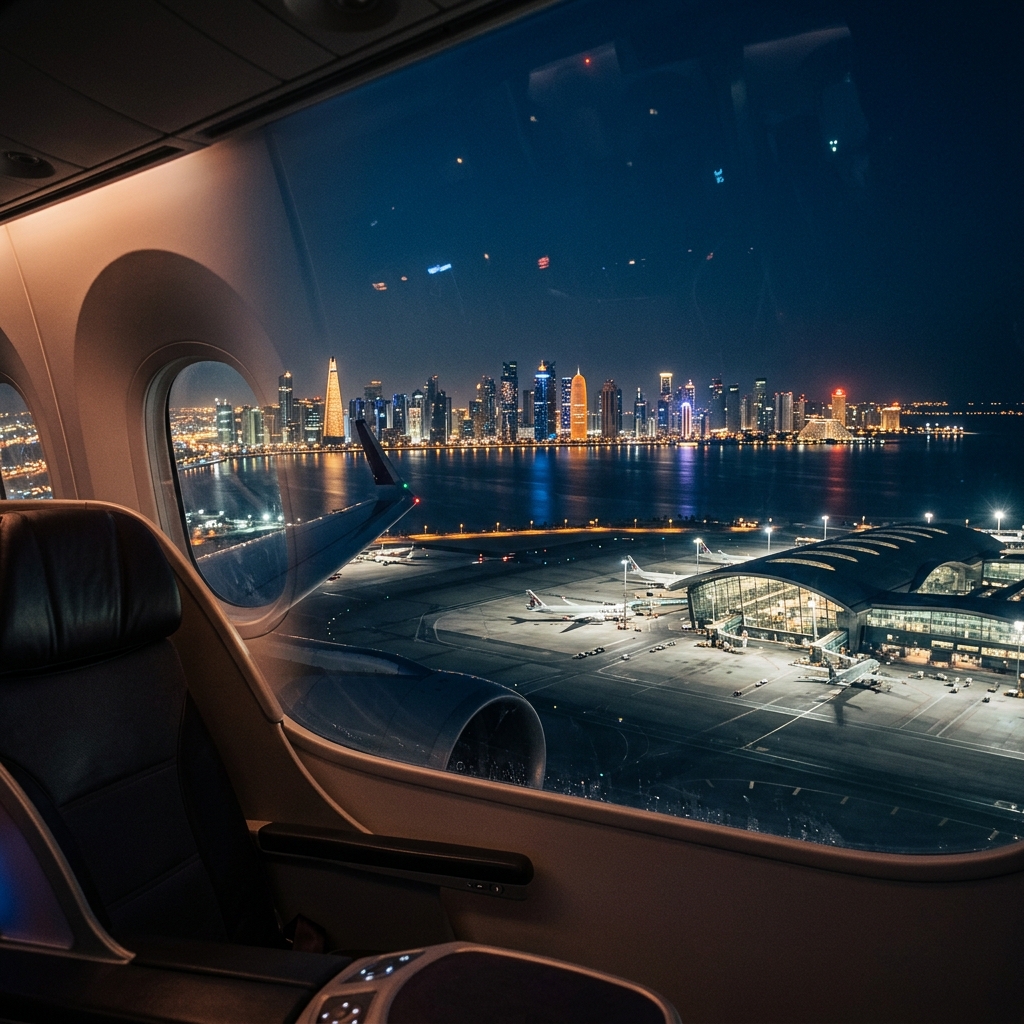 Above: Departing Hamad International Airport at night — the airport's architectural precision and 24-hour operational tempo make Doha one of the most functionally efficient long-haul transit hubs in global aviation.
Any rigorous evaluation of Qatar Airways as a long-haul carrier must include an assessment of Hamad International Airport in Doha, because the two are operationally inseparable. Qatar's geographic position — approximately equidistant between Europe and East Asia, and within a standard single-sector range of virtually every major city across Africa, the Indian Subcontinent, Southeast Asia, and Australasia — makes Doha a structurally logical transit node. Hamad International Airport exists to activate that geography.
The Transit Architecture
Hamad International Airport (IATA: DOH) operates as a continuous-flow airport without true off-peak periods. Because Qatar Airways serves destinations across multiple time zones simultaneously, departures and arrivals are distributed evenly across the full twenty-four-hour clock. This continuous operational rhythm has significant practical implications for the transit passenger.
Transit dwell times of two to four hours — which constitute a dead zone at many hub airports where restaurants close, lounges fill beyond capacity, and retail shuts down — are unremarkable at Hamad. The airport's physical design, an elongated concourse with consistent commercial and F&B density across its full length, means that the experience of a two-hour transit at midnight is largely identical to a two-hour transit at noon. For frequent long-haul travelers who connect through Doha multiple times per year, this consistency is a form of reliability that compounds.
Al Mourjan Business Lounge
For passengers traveling in QSuite or Business Class, access to the Al Mourjan Business Lounge is included. The lounge occupies a considerable footprint within the concourse and divides its offering between a restaurant section with à la carte service, a quieter seating area with a central reflecting pool, dedicated shower suites available on a first-come reservation basis, and a separate sleeping room section with reclining seats. The dining quality within Al Mourjan is meaningfully above the standard airport lounge offering — the kitchen operates a rotating menu and maintains table service rather than buffet format for the full dining section.
3. Route Network and Operational Precision
Qatar Airways operates to over 170 destinations across six continents. The route network is organized around Doha as a single hub, which creates a fundamentally different operational dynamic from carriers that distribute traffic across multiple competing hubs. Single-hub architecture concentrates connecting traffic, which allows the carrier to operate higher-frequency service on spoke routes and maintain tighter minimum connecting times without the interline transfer penalties common to multi-hub systems.
For the frequent traveler whose itinerary connects a secondary city — say, a regional European capital or a mid-tier Southeast Asian destination — to a long-haul transatlantic or transpacific sector, this hub structure can produce meaningfully shorter total journey times compared to routing through a geographically less optimal hub.
Oneworld Alliance Membership and Frequent Flyer Integration
Qatar Airways is a full member of the Oneworld alliance, which provides codeshare connectivity, lounge access reciprocity, and frequent flyer mile earning and redemption across a network of aligned carriers. For the Privilege Club member, this means that miles accumulated on Qatar Airways sectors can be applied toward redemptions on partner carriers, and vice versa. The practical value of this integration depends on the traveler's home carrier and primary routing patterns, but for a frequent long-haul traveler who combines Qatar Airways with two or three Oneworld partners across a travel year, the cumulative mile balance can represent material redemption value.
On-Time Performance and Operational Discipline
Across the fourteen sectors evaluated in our audit, Qatar Airways maintained an on-time departure record of twelve out of fourteen sectors, with the two delays attributable to ground-side factors at non-Doha departure airports. Arrival performance was consistent with published schedules, a meaningful data point for passengers connecting onward through Doha with tight minimum connection windows.
4. In-Flight Service: The Cabin Crew Standard
The operational quality of a premium cabin product depends ultimately on the human layer that mediates between the physical product and the passenger. In our evaluation across multiple cabin crew compositions and route sectors, Qatar Airways' business-class service maintained a consistent standard defined by two characteristics: proactive anticipation and minimal interruption.
Proactive anticipation means that the crew restocked water glasses before empty, offered menu items in sequence without requiring passenger-initiated requests, and redistributed cabin lighting during sleep phases without prompting. Minimal interruption means that service deliveries during sleep windows — blanket distributions, amenity kit placements — were completed without waking passengers who had reclined.
These are not behaviors that emerge from scripted training alone. They reflect a staffing ratio that allows attentive coverage. On the Boeing 777 QSuite configuration, the business-class cabin typically operates with a crew-to-passenger ratio that allows individualized attention rather than zone-based mass service.
The Dine on Demand Model
Qatar Airways operates a dine-on-demand service in Business Class on most long-haul sectors. Passengers may request meals at any point during the service window rather than conforming to a single scheduled meal delivery. This is a structural improvement over fixed-tray service that has meaningful implications for passengers traveling across multiple time zones who choose to manage their meal timing around sleep and destination arrival rather than around cabin crew workflow.
The menu is regionally calibrated: sectors originating from or arriving at Asian destinations typically include substantively different options from sectors operating on European or American routes. Wine and beverage selection is curated rather than standard, with a distinct offering that varies by sector and season.
5. Economy and Premium Economy: What Deliberate Selection Looks Like Below Business Class
A complete audit of Qatar Airways must acknowledge the full cabin range, because the carrier's network value extends well beyond the QSuite. For travelers whose journey frequency or budget does not support consistent business-class travel, Qatar Airways maintains a competitive economy product and a Premium Economy class on select aircraft types.
Economy on the Airbus A350 long-haul configuration offers 32 to 33 inches of seat pitch, which places it within the acceptable range for sector lengths up to ten hours. The Oryx One in-flight entertainment system — available across all cabin classes — delivers one of the larger content libraries in commercial aviation, with a system that responds reliably across long sectors without the buffering and reset failures common to older IFE hardware.
Premium Economy, where available, adds meaningful pitch and recline increments over Economy alongside a dedicated cabin crew allocation and a distinctly calibrated meal service. For a ten-to-fourteen-hour sector where full business-class pricing represents a significant overhead, Premium Economy can represent a rational calibration for the traveler who prioritizes rest quality over full suite isolation.
Booking Considerations: A Practical Checklist
Before committing to a fare on any Qatar Airways sector, verify these five conditions to ensure your booking matches the product you expect:
- Aircraft type assigned to your sector: QSuite is not available on all Qatar Airways aircraft. Confirm the aircraft type on your specific flight and cross-reference it against published cabin configuration guides. A Boeing 777-300ER assigned to your route is the primary QSuite carrier; an older Boeing 777-200LR or select A320 narrowbody regional aircraft will carry a different seat product.
- Doha connection minimum time: If connecting through Hamad International Airport, verify the minimum connecting time published for your specific pairing. Qatar Airways publishes official minimum connection standards; booking below these windows on a self-constructed itinerary creates misconnect risk.
- Privilege Club redemption rates: If booking on miles, confirm the current Avios or Qmiles redemption chart before assuming a historical redemption rate. Programs adjust their charts periodically.
- Lounge eligibility conditions: Al Mourjan access requires Business Class or Privilege Club status. Confirm your eligibility tier before building your airport transit plan around lounge access.
- Dine on demand availability: This feature is available on most long-haul sectors but not universally on shorter regional routes. Verify the service specification on your sector before timing your pre-flight meal accordingly.
Qatar Airways operates one of the most coherent premium long-haul products currently available in commercial aviation. For the deliberate long-haul traveler whose journey combines sector length, transit convenience, and cabin product integrity, it represents a standard against which alternatives are usefully measured.