A western boot is one of the few articles of footwear whose construction vocabulary has remained essentially unchanged across a century and a half of production. The last, the welt, the stacked leather heel, the pull straps set into the shaft seam — these are not ornamental choices. They are engineering decisions that determine whether a boot will hold its shape across a decade of wear or collapse at the heel counter after a single season. The problem for most buyers is that the vocabulary of good construction is invisible at the point of purchase. A boot can be photographed beautifully, priced attractively, and assembled from materials that bear no resemblance to what the product photography implies.
Rujo Boots builds western footwear in the traditional handcrafted format, with an emphasis on full-grain leather construction, Goodyear welt assembly, and a fit profile designed for the long break-in arc that a properly made leather boot requires. This guide examines the construction elements that determine long-term value in western footwear, and where a handcrafted boot like those offered by Rujo Boots stands in relation to the mass-market alternatives that dominate the mid-price western footwear shelf.
This is a reader-supported guide. Some links below are affiliate links. If you make a purchase through them, Last Meadow Guide may earn a commission at no additional cost to you. Fit and sizing vary by last; always consult the brand's sizing guidance before purchasing.
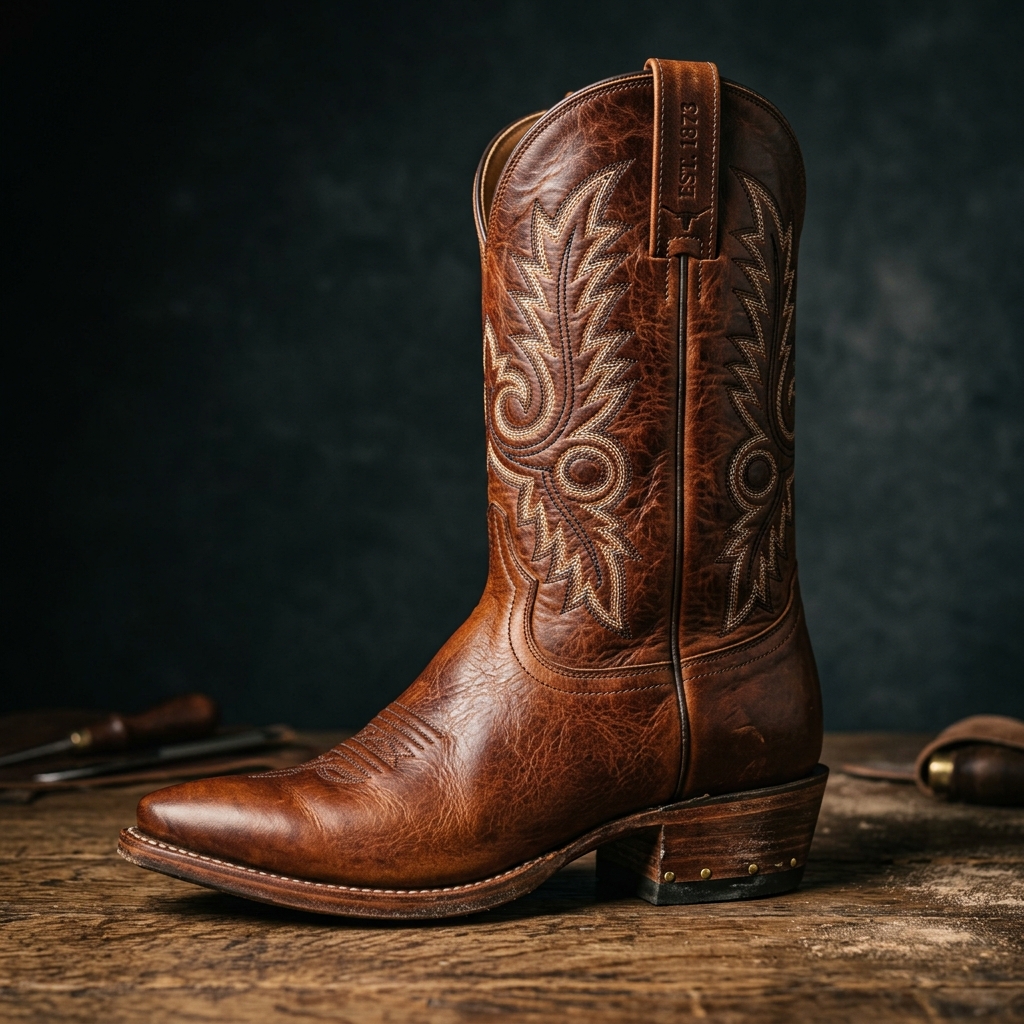 Above: The hallmarks of quality western construction — full-grain leather with visible natural temper, densely stitched shaft embroidery, stacked leather heel, and a single-piece vamp — are all readable in a well-photographed boot before the first fitting.
1. Leather Selection: Why Grade Determines Everything That Follows
The single most important decision in western boot construction is the leather. Not the stitching pattern, not the heel height, not the toe shape — the leather. Every other quality indicator downstream of the upper material is contingent on the leather grade chosen for the vamp and shaft.
Full-Grain vs. Corrected-Grain vs. Bonded Leather
Full-grain leather is the outermost layer of the hide, cut and finished without sanding or buffing the surface to remove natural imperfections. It retains the hide's original grain structure — the tight, interlocking fiber network that gives the leather its tensile strength, its resistance to moisture penetration, and its capacity to develop a patina over years of wear. A full-grain leather boot that is properly conditioned will become more structurally cohesive with age, not less. The fiber network compresses and conforms to the wearer's foot geometry over the break-in period, producing a fit that no synthetic material can replicate because no synthetic material undergoes the same structural transformation.
Corrected-grain leather has had its surface sanded to remove blemishes, then embossed with an artificial grain pattern. It presents a uniform, clean appearance at the point of purchase and photographs attractively. It does not, however, possess the same fiber density as full-grain leather — the sanding process removes the tightest, most moisture-resistant layer of the hide. Corrected-grain leather will not develop a patina in the way full-grain does, and its long-term wear resistance is meaningfully lower.
Bonded leather — a composite of leather scraps and polyurethane binder — has no place in a discussion of quality western footwear. It is included here only because it appears in the market under descriptions that can mislead buyers who are not reading carefully.
Rujo Boots works in full-grain and premium exotic leathers across its collection. For a buyer evaluating a handcrafted western boot at any price point, this is the first qualifier that separates a genuine investment piece from a well-marketed imitation.
Exotic Uppers: Caiman, Ostrich, and Teju Lizard
Beyond bovine full-grain leather, the western boot tradition includes a specific category of exotic upper materials whose structural and aesthetic properties differ substantially from standard cowhide. Understanding what each exotic material offers allows a buyer to evaluate whether the premium is justified for their specific use case.
Caiman crocodilian uppers — harvested from the belly or leg sections of the hide — present the hardened, interlocking osteoderms (bone-embedded scales) that are the defining visual characteristic of reptile leather. The osteoderm structure makes caiman leather exceptionally resistant to abrasion and scuffing, which explains its popularity in western boots worn in rough terrain. The material does not flex as readily as cowhide, which means that caiman-front boots are typically constructed with a full-grain leather shaft and a caiman vamp only, allowing the shaft to flex during walking while the vamp retains its rigid, burnished appearance.
Ostrich full-quill leather is cut from the center of the ostrich skin, where the raised follicle quill bumps are most pronounced. The quill pattern is a natural structural feature — each raised bump corresponds to a feather follicle shaft — and its presence is the primary marker distinguishing genuine ostrich from imitation. Ostrich leather is notably soft and supple relative to its durability, which makes it one of the more comfortable exotic upper materials across extended wear. It conditions readily with standard leather care products and develops a rich, deepening sheen over time.
Teju lizard panels, most commonly applied to the toe box and vamp, present a fine, regular scale pattern that provides a sharp visual contrast against a full-grain shaft. Because teju lizard hides are small, most lizard western boots use the exotic material selectively on the toe vamp only, with the remainder of the boot constructed in cowhide or caiman leather.
2. Welt Construction: The Structural Joint That Defines Repairability
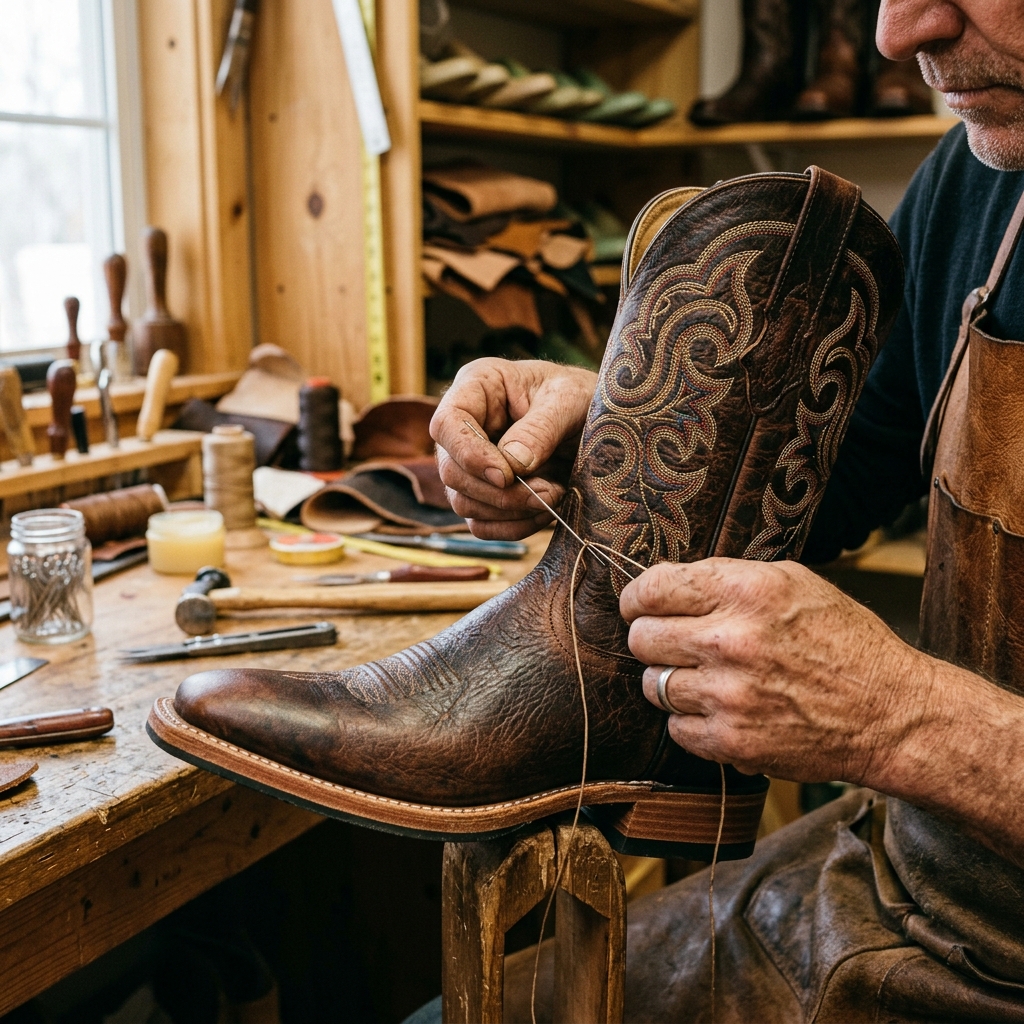 Above: The welt stitch — visible as a continuous line of locking thread along the joint where the insole, welt strip, and outsole converge — is the construction detail that most directly determines whether a boot can be resoled and worn for decades.
The welt is the strip of leather that joins the upper to the outsole. It is, functionally, the structural seam of the boot — and the method by which it is attached determines whether the boot can be repaired and resoled or must be discarded when the outsole wears through.
The Goodyear Welt
In Goodyear welt construction, the upper leather is stitched to a welt strip along the insole channel, and the outsole is then stitched to the exterior of that welt strip in a separate operation. The two-stitch system creates a structural joint that can be separated at the outsole-to-welt seam without disturbing the upper-to-welt seam. A cobbler can remove the outsole, replace it with a new one, and re-stitch through the existing welt — restoring the boot's functional life without altering the upper leather.
A pair of Goodyear welted western boots that are maintained and resoled at appropriate intervals can remain in active rotation for fifteen to twenty-five years. The economics are straightforward: a higher initial purchase price distributed across two decades of wear, with two or three resole operations at a cost of $80 to $150 each, produces a lower cost-per-wear figure than any entry-level boot that cannot be resoled and must be replaced entirely when the outsole degrades.
Cement Construction (Glued Outsole)
In cemented or glued construction, the outsole is bonded to the upper using industrial adhesive. There is no welt strip and no stitched joint. When the adhesive bond degrades — which it will, under the combination of heat, moisture, and mechanical flex — the outsole separates from the upper. Cement construction cannot be meaningfully resoled by a traditional cobbler; the structural architecture is not designed for disassembly and reassembly.
Cement-constructed boots are not inherently poor footwear. They can be comfortable, well-lined, and attractively designed. They are simply disposable footwear in the most literal sense: when the sole goes, the boot is finished. For a buyer making a long-term investment in western footwear, this is the disqualifying factor.
The welt seam is the single most useful construction detail to inspect before purchasing any western boot. On a Goodyear welted boot, it is visible as a raised ridge of stitching running along the perimeter of the outsole edge. Its absence — a smooth, seamless transition from upper to outsole — indicates cement construction.
3. The Shaft: Embroidery, Height, and the Break-In Arc
The shaft is the upper portion of the boot that covers the leg from the ankle to just below the knee on a traditional pull-on western. Its construction involves several decisions that affect both the visual character of the boot and its practical fit over time.
Shaft Height and the Riding Fit
Traditional western shafts measure between 12 and 14 inches in height, with the taller options providing greater calf coverage and the historic riding silhouette. For a boot worn primarily in a non-equestrian context — daily wear, event dress, or light outdoor use — shaft height is largely an aesthetic choice, though taller shafts provide more substantial calf coverage in cold and wet conditions.
The pull straps — twin loops set into the shaft seam at the top edge — are functional hardware, not decorative trim. They distribute the pulling force required to seat the foot fully through the tight instep of a western last, preventing the shaft leather from wrinkling permanently at the pull points. A well-made pull strap is reinforced at its attachment seam with a secondary layer of leather or heavy linen canvas.
Shaft Embroidery: Structural and Decorative
The stitching that covers the shaft of a western boot is produced on a specialized embroidery machine capable of maintaining consistent thread tension across curved leather surfaces. The stitching serves a secondary structural purpose beyond its visual function: it reinforces the leather panel and prevents the shaft from collapsing laterally under the flex stress of walking. A densely stitched shaft maintains its cylindrical profile and resists creasing at the ankle seam more effectively than an unstitched panel.
The design vocabulary of shaft stitching — scrollwork, floral motifs, geometric border patterns — is one of the primary aesthetic differentiators across western boot makers. Rujo Boots offers multiple embroidery patterns across its collection, from restrained single-color border stitching suited to a dress context to more elaborate multi-panel designs in contrasting thread colors.
4. The Toe Shape and Heel Stack: Functional Geometry
Western boots are produced across several toe profiles, each with a specific historical and functional origin. The choice among them is partly aesthetic and partly ergonomic.
Toe Profiles
| Toe Style | Profile | Primary Context |
|---|---|---|
| Pointed (J-toe) | Sharply tapered, narrow tip | Dress and formal western wear |
| Round toe | Broader, rounded tip | All-day comfort and casual wear |
| Square toe | Flat-fronted, wide tip | Contemporary western, wider toe box |
| Snip toe | Medium taper, blunted point | Crossover dress and field use |
The pointed toe — the J-toe in traditional nomenclature — is the silhouette most associated with formal western dress. Its narrow profile fits the stirrup cleanly and presents a sharp, elongated line that reads as intentionally dressed. For buyers whose primary context is all-day stand-and-walk wear, the round or square toe provides meaningfully more forefoot volume and reduces the break-in discomfort common in narrow-toed lasts.
The Stacked Leather Heel
A stacked leather heel is built from individual layers of leather — typically seven to twelve lifts of approximately 3mm thickness each — bonded and compressed together and finished to a smooth, beveled edge. The stacked construction allows individual lift layers to be replaced as the heel wears, without requiring a full resole operation. The heel height on a traditional western boot runs between 1.5 and 2 inches, measured at the back of the heel. This elevation creates the characteristic western silhouette and provides the slight forward pitch that locks the foot against the stirrup.
A rubber heel cap — a small block of durable rubber set into the base of the stacked heel — extends the life of the heel stack and reduces slip on hard floors. Its presence is a useful marker of practical construction intent, separate from purely traditional aesthetics.
5. Break-In: What to Expect from Full-Grain Leather and How to Accelerate It Correctly
The break-in period of a properly constructed full-grain western boot is a non-negotiable property of the material. It is not a manufacturing defect. It is the process by which the leather fibers of the vamp and shaft conform to the specific geometry of the wearer's foot and ankle. Buyers who expect immediate comfort from a stiff new western boot will misread this process as poor fit and return a boot that would have become exceptional with an additional two to four weeks of wear.
The Break-In Timeline
- Days 1 to 7: The boot will feel tight across the instep and may create pressure points at the toe box and ankle collar. Wear for short durations — one to two hours — and alternate with a broken-in shoe to allow the leather to relax incrementally.
- Days 7 to 21: The instep leather begins to compress to the foot's arch profile. The ankle collar softens and stops gripping the Achilles tendon. Wear duration can extend to four to six hours.
- Days 21 to 45: The boot approaches its final fit. The vamp conforms to the ball-of-foot width. The shaft develops the characteristic break crease just above the ankle that indicates the leather has reached its structural equilibrium.
Conditioning During Break-In
Apply a neutral leather conditioner — mink oil, neatsfoot oil, or a commercial leather balm — to the vamp and shaft during the break-in period. Conditioning the leather while it is actively flexing accelerates fiber relaxation without damaging the grain structure. Do not apply heat (hair dryers, direct sunlight, heating vents) to accelerate softening; heat degrades the leather's structural fiber bonds and shortens the boot's long-term service life.
6. A Western Boot Buyer's Inspection Checklist
Before purchasing any western boot — in-store or online — verify these construction markers:
- Upper leather grade: Confirm the product description specifies full-grain leather. If the description uses "genuine leather," "bonded leather," or omits the grade entirely, the leather quality is likely corrected-grain or lower.
- Welt visibility: On a Goodyear welted boot, the welt stitching is visible as a raised ridge along the outsole perimeter. Photograph or examine the outsole edge before purchasing. A smooth, flush outsole edge without visible stitching indicates cement construction.
- Heel construction: Inspect the heel profile. A stacked leather heel shows distinct horizontal layer lines at the heel face. A molded rubber heel — regardless of how it is described — is a single continuous piece.
- Pull strap attachment: Pull straps should be stitched to the shaft at both their base and their upper edge. A single-stitch attachment will tear under repeated pulling force.
- Shaft stitching density: Dense, tightly packed embroidery stitching indicates a properly tensioned embroidery operation. Loose or uneven stitching — visible as threads that do not lie flat against the leather — indicates inadequate machine tension or speed.
- Sizing reference: Western lasts run narrow through the instep relative to athletic shoe sizing. For most buyers, ordering one half-size up from a standard athletic shoe size is a reasonable starting point; consult the brand's specific sizing chart before committing.
A handcrafted western boot built to these standards is a long-term footwear investment — one that improves with age, can be maintained indefinitely with proper care, and eventually produces a fit that no off-the-shelf alternative can match. Rujo Boots builds within this tradition, and for a buyer who understands what they are purchasing and is willing to invest in the break-in process, the return on that investment compounds across years of wear.